
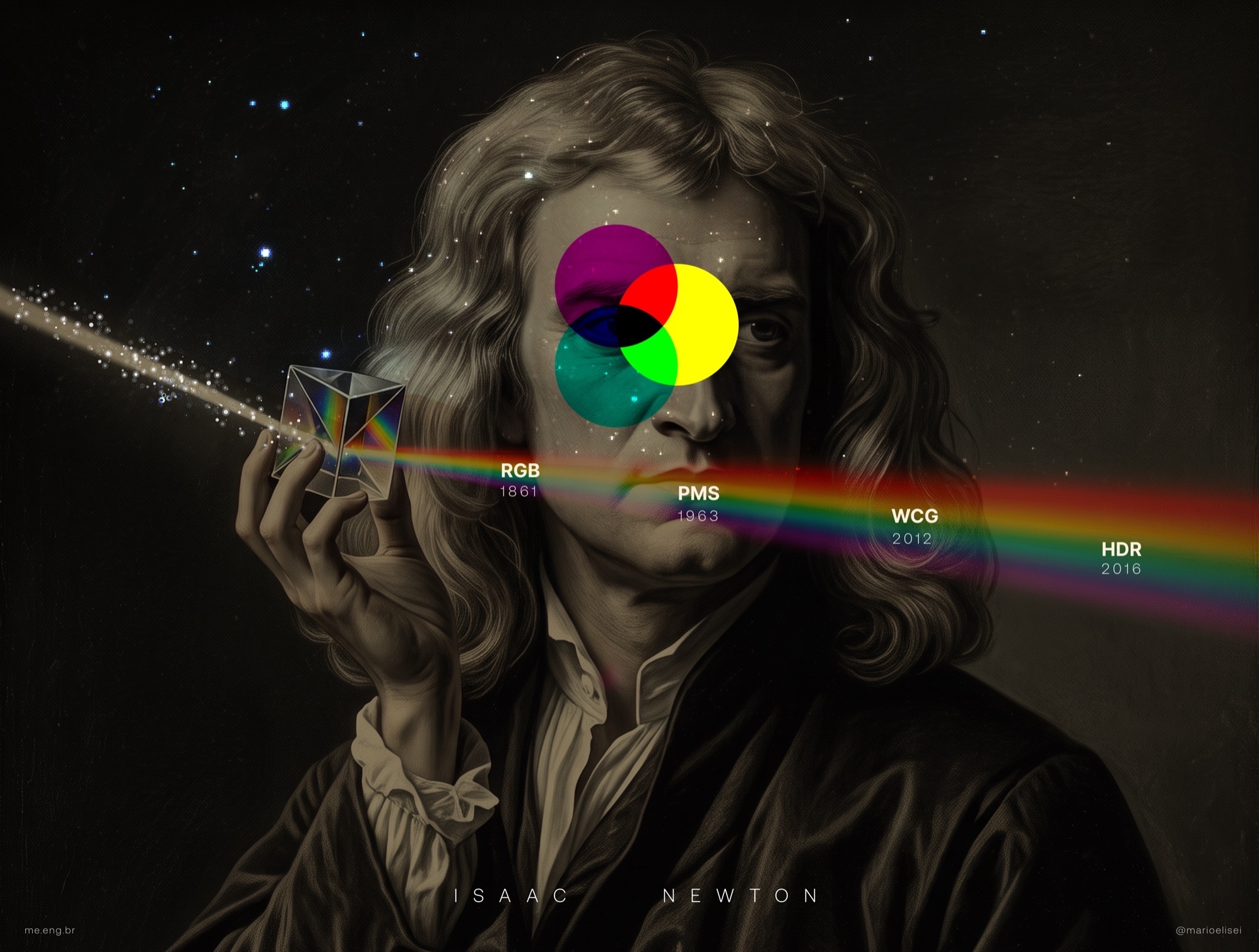
// Science · Art · Engineering — 01
Ibn Sahl · 984
Newton · 1666
Fermat · 1662
17 ps/(nm·km)
I · Science
01The bend is a side effect
Light does not bend because glass pushes it. It bends because it slows down, and the two edges of a wavefront do not slow at the same instant. The refractive index is nothing more than that ratio — n = c/v. Everything else in this article is bookkeeping.
The bookkeeping was first written down in Baghdad in 984. Ibn Sahl set it out in a treatise on burning mirrors and used it to design a lens free of spherical aberration. Snellius restated it in 1621, Descartes published it in 1637, and the manuscript preceding them both by six centuries was identified only in 1990. The law kept the wrong name: attribution is a social process, not a physical one.
Dispersion is one further step. n is not a constant of a material — it is a function of wavelength. Blue slows more than red in glass, so blue bends more. The cause is resonance: electrons bound inside the material have their own natural frequencies, and light closer to them interacts more strongly. Dispersion is not a quirk of prisms; it is what resonance looks like under white light.
02The second prism
Everyone knows the first prism. Almost nobody knows that it proves nothing.
A prism turning white light into a spectrum is equally consistent with the theory Newton set out to kill — that glass adds colour to light in proportion to how much glass the beam crosses. Both explanations predict exactly the same photograph.
Newton’s experimentum crucis, at Woolsthorpe in 1666, was the second prism. He placed a screen with a small hole behind the first one, isolated a single colour, and sent that beam alone through a second prism. If glass coloured light, the second prism would have coloured it further. It did not. The red stayed red, deviated by precisely the amount its own index predicted, and refused to decompose.
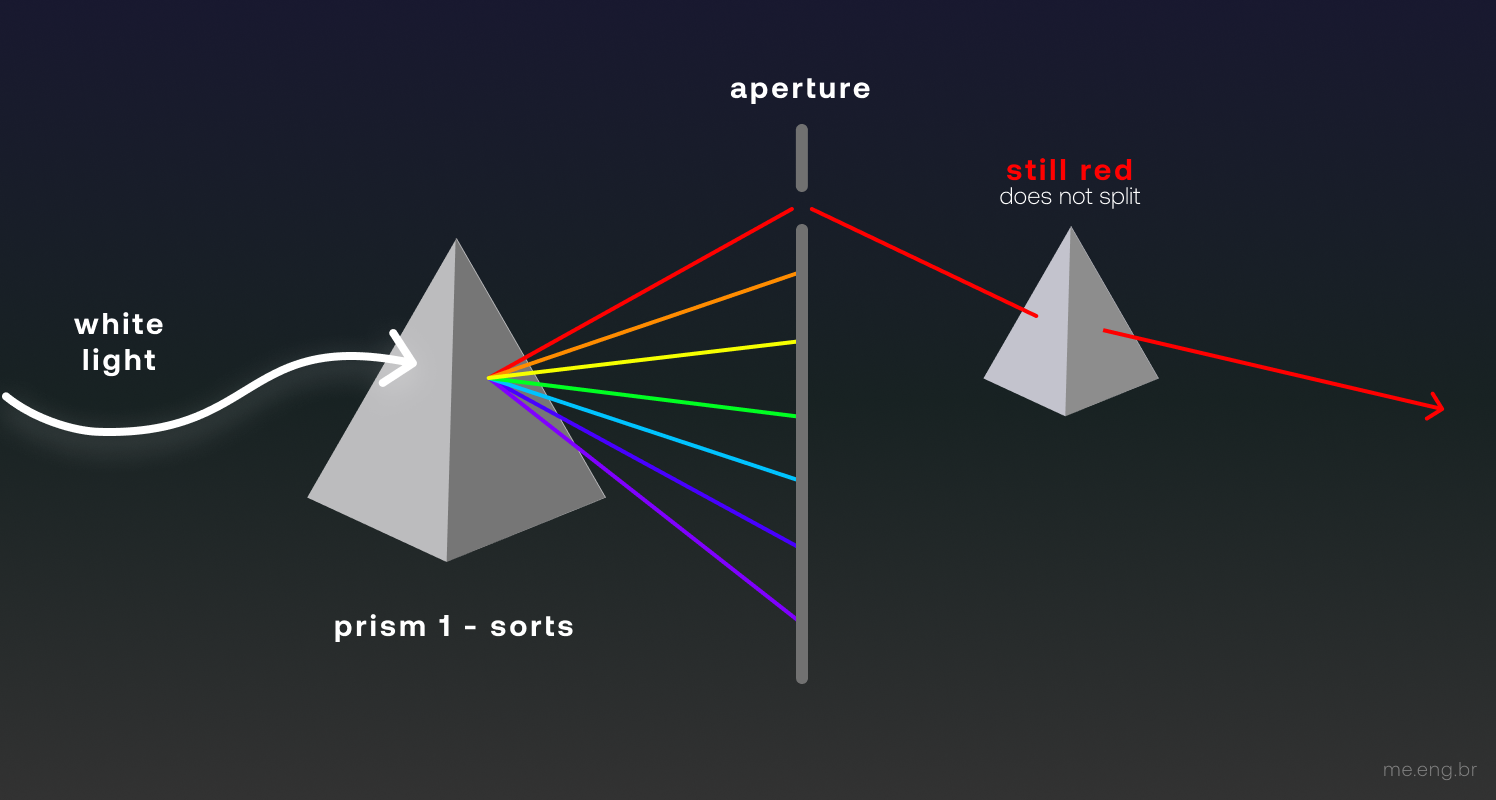
This is the shape of every honest measurement: the first experiment produces the striking image, and the second one eliminates the alternative that would have produced the same image.
II · Mathematics
03Light solves an optimization problem
In 1662 Fermat proposed that light travels the path of stationary time — not the shortest distance, the shortest duration. Write down the geometry, differentiate with respect to the crossing point, set the derivative to zero, and Snell’s law falls out.
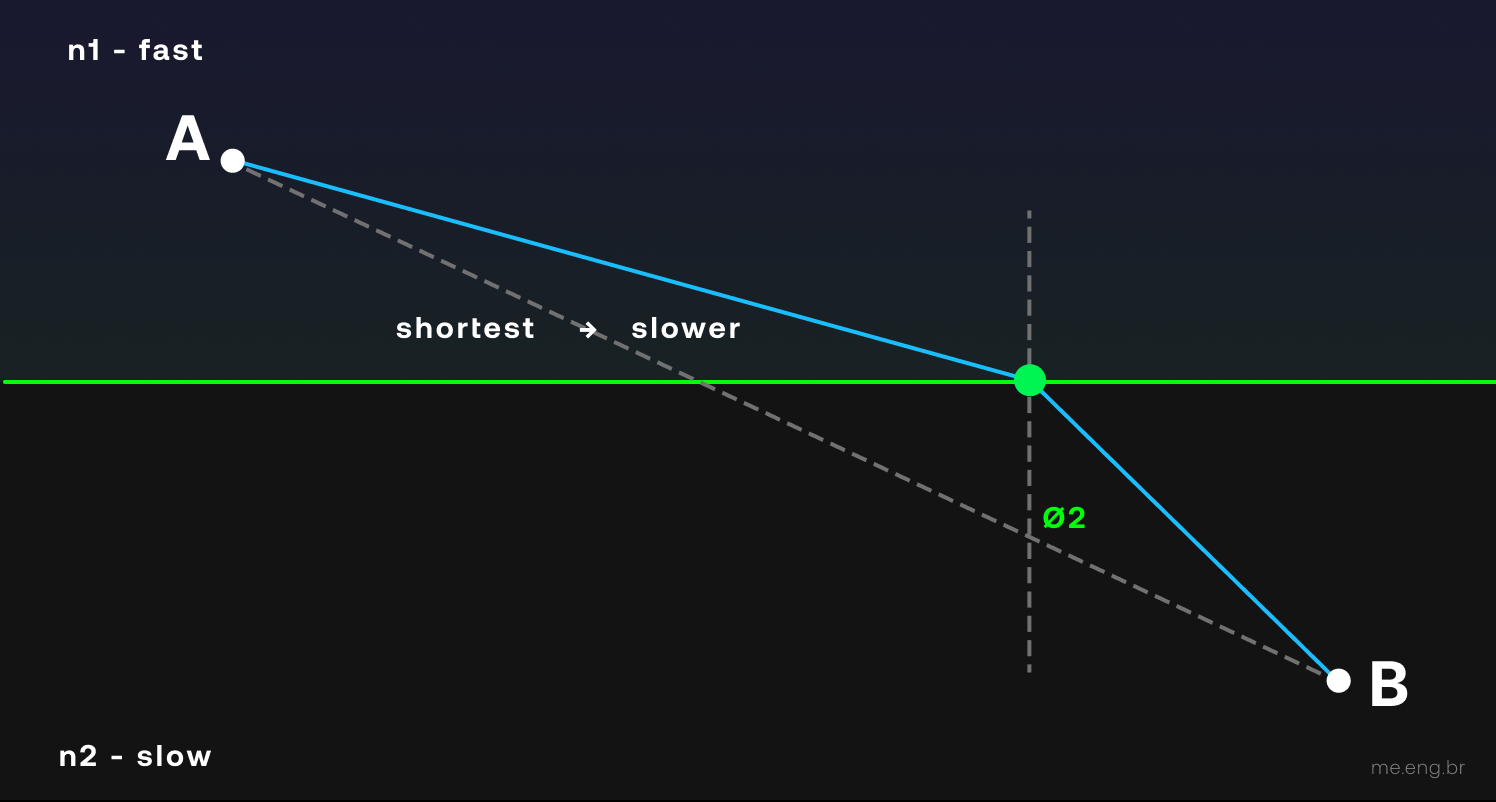
That reframing matters more than the formula. Refraction is not a rule about light. It is the first-order condition of a minimum. The same variational calculus produces Lagrangian mechanics and, with the domain changed, every gradient step in a training loop. Light finds the optimum for the same reason a network does: that is what a stationary point of a smooth objective looks like.
The part where someone chooses an error
Exact optics is expensive, so applied refraction is a history of successively cheaper approximations. Cauchy fitted n(λ) with a polynomial in 1836; Sellmeier improved it in 1871 with a form derived from those electron resonances; Abbe compressed a glass’s entire dispersive behaviour into a single number.
And in 1994 Christophe Schlick published an approximation to the Fresnel equations — which govern how much light reflects rather than refracts at a given angle — replacing a trigonometric computation with a fifth power:
It is not correct. It is close enough, it costs almost nothing, and it is therefore what runs inside every real-time renderer you have ever looked at. That is the entire bridge from physics to software, in one line: somebody decides which error is acceptable, and that decision is the engineering.
III · Art & Design
04Newton chose seven
The spectrum is continuous. There are no bands in it, no edges, no natural places to cut. Newton reported seven colours — and he chose seven because he wanted the divisions to correspond to the seven intervals of the musical scale.
Indigo sits in your primary-school mnemonic because of an analogy to music published in 1704.
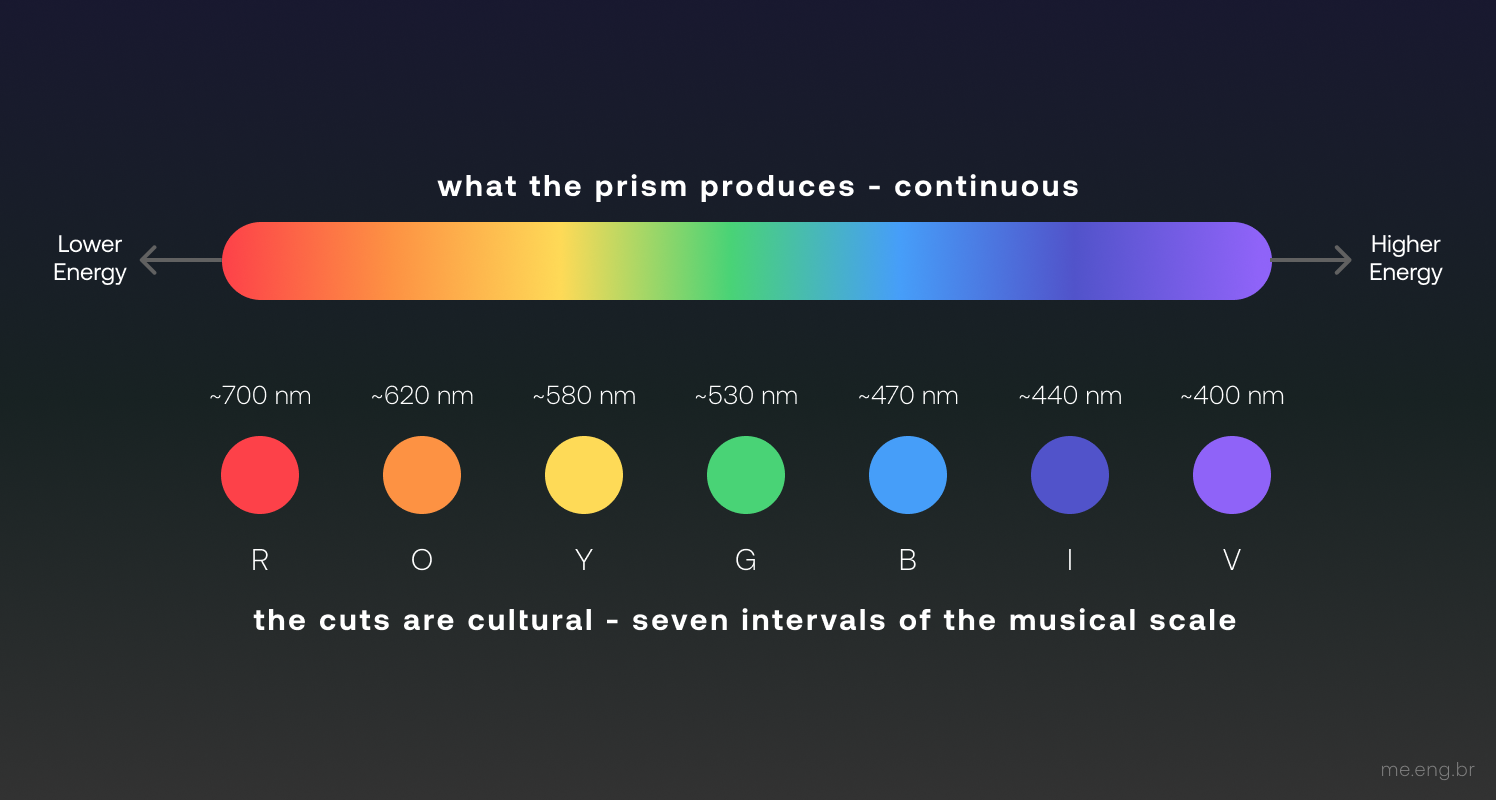
This is the first act of design on any continuum, and it is always arbitrary: you cut it into steps, and the steps outlive the reason for them. Same decision as the rungs of a type scale, the greys in a palette, the breakpoints in a grid. Nothing in the quantity tells you where the cuts belong. Somebody picks; everybody inherits.
The prism on the cover of The Dark Side of the Moon (1973, Hipgnosis) is the most reproduced piece of physics illustration in history, and it is optically wrong — the beam enters without refracting and the spectrum leaves with parallel edges. Nobody minds, because it is a diagram of an idea, not of an experiment. Chromatic aberration went the same way: a defect the optical industry spent a century engineering away, adopted as a style. Then glass reached the screen, and refraction became the interface’s way of saying there is something behind this layer.
And the cutting never stopped. Everything we use to name a colour descends from that first split — each one a different decision about where the boundaries go, each as invented as indigo.
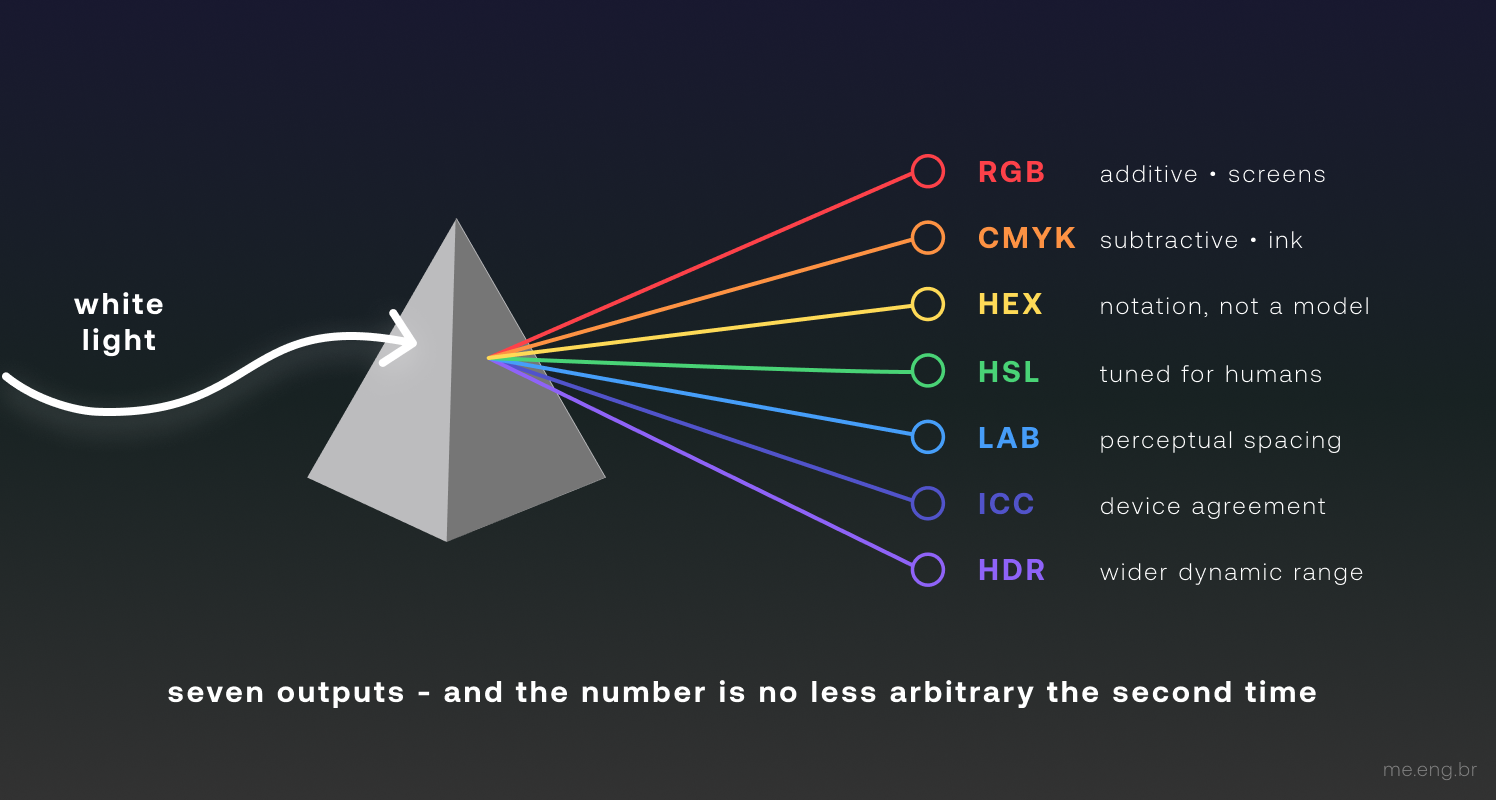
But every colour space is a choice about where to cut the thing a prism produces.
IV · Engineering
05Three places it charges you
Render
Snell in the shader, Fresnel via Schlick, Beer–Lambert for the colour of thick glass. But one limit is worth stating plainly: RGB rendering cannot produce dispersion. Three channels carry no spectral resolution. A real prism needs wavelength samples, and you pay for every one. The chromatic aberration in your favourite game is not dispersion — it is the red and blue channels offset radially in a post-process. A convincing forgery, and an honest one, as long as nobody calls it physics.
Interface
An element with backdrop-filter is frosted glass on your screen, and among the most expensive things you can ask a compositor to do. It forces its own compositing layer and a read of everything painted behind it, inside a 16.7 ms budget at 60 fps. On a static header, cheap enough. On a list that scrolls, it is the GPU re-reading the backdrop every frame, on a battery.
Network
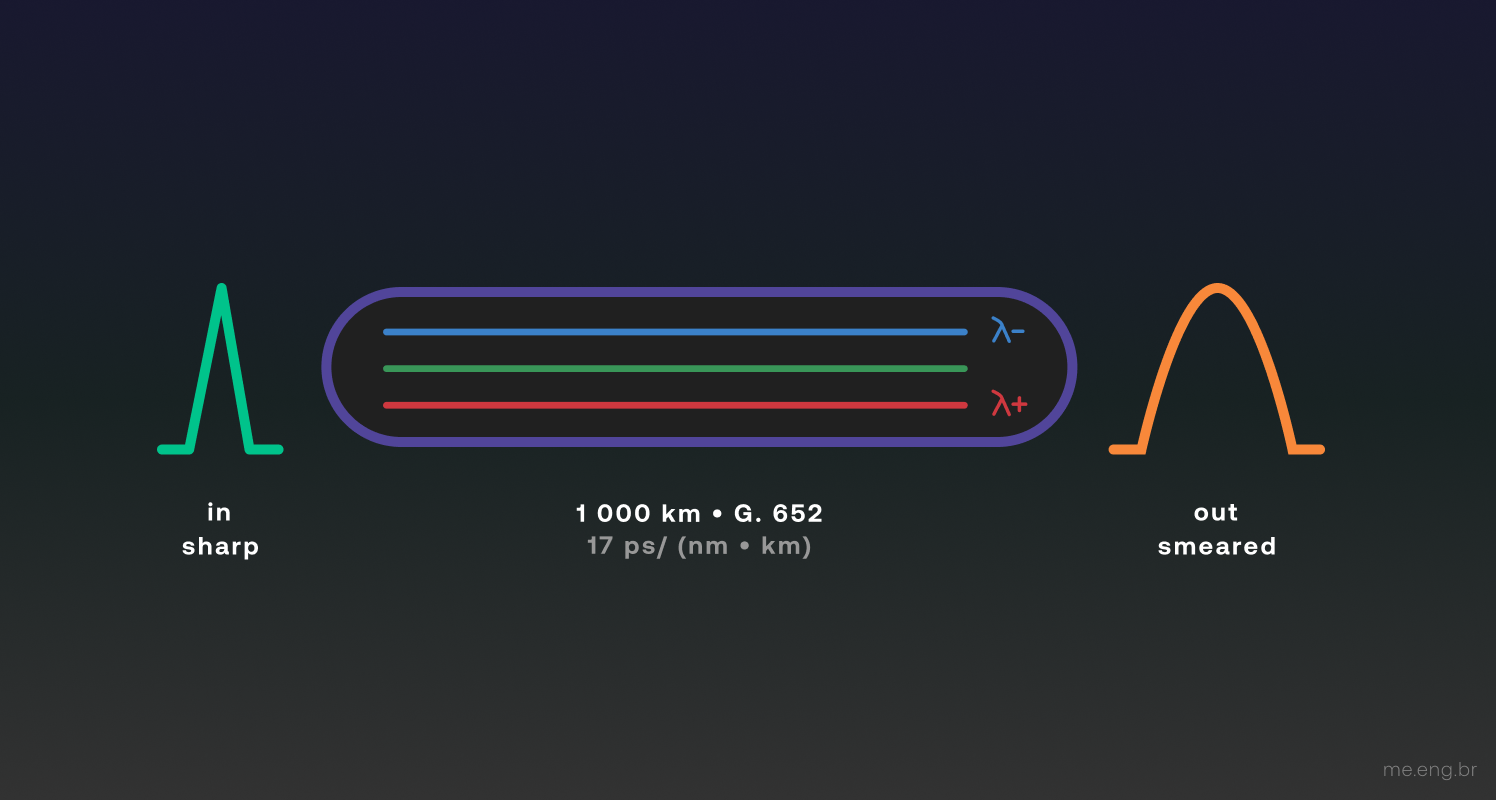
And the one nobody connects back to prisms. In long-haul fibre, chromatic dispersion is the ceiling on bandwidth. A laser pulse is not one wavelength but a narrow band, and each wavelength travels at its own speed. Standard single-mode fibre disperses at roughly 17 picoseconds per nanometre per kilometre at 1550 nm — over a thousand kilometres, a pulse a few nanometres wide smears by tens of nanoseconds. Symbols overlap; bits are lost. Dispersion-shifted fibre, compensating modules and DWDM channel spacing all exist to fight the same n(λ) that makes a rainbow.
06The physical translation
Seventeen picoseconds per nanometre per kilometre. That single figure carries the whole chain.
The wavelength dependence of the refractive index — what Newton demonstrated with two prisms in a Lincolnshire farmhouse in 1666 — is the same property that decides how many bits per second fit inside a glass thread on the floor of the Atlantic. Every packet that delivered this page crossed a medium where dispersion was the adversary, and the amplifiers and compensating spools exist to cancel it out.
The rainbow and the bandwidth ceiling are the same equation, read in opposite directions.
07In practice
- Put
backdrop-filterover anything that moves and you have bought a per-frame backdrop read. Measure it on the cheapest device you support. - If a render needs true dispersion, no amount of RGB post-processing gets you there — you need wavelength samples. That changes the renderer, not the shader, so decide early.
- When you discretise a continuum — colour, type sizes, spacing, breakpoints — write down why you chose those cuts. Newton’s reason was music, and it outlived him by three centuries.
08Sources
- Ibn Sahl · On Burning Instruments, c. 984 — identified by Roshdi Rashed, 1990
- Snellius 1621 · Descartes, La Dioptrique, 1637
- Newton · Philosophical Transactions, 1672 · Opticks, 1704
- Fermat · principle of least time, 1662
- Cauchy 1836 · Sellmeier 1871 · Abbe number
- Schlick · An Inexpensive BRDF Model for Physically-based Rendering, 1994
- ITU-T G.652 · single-mode fibre dispersion characteristics